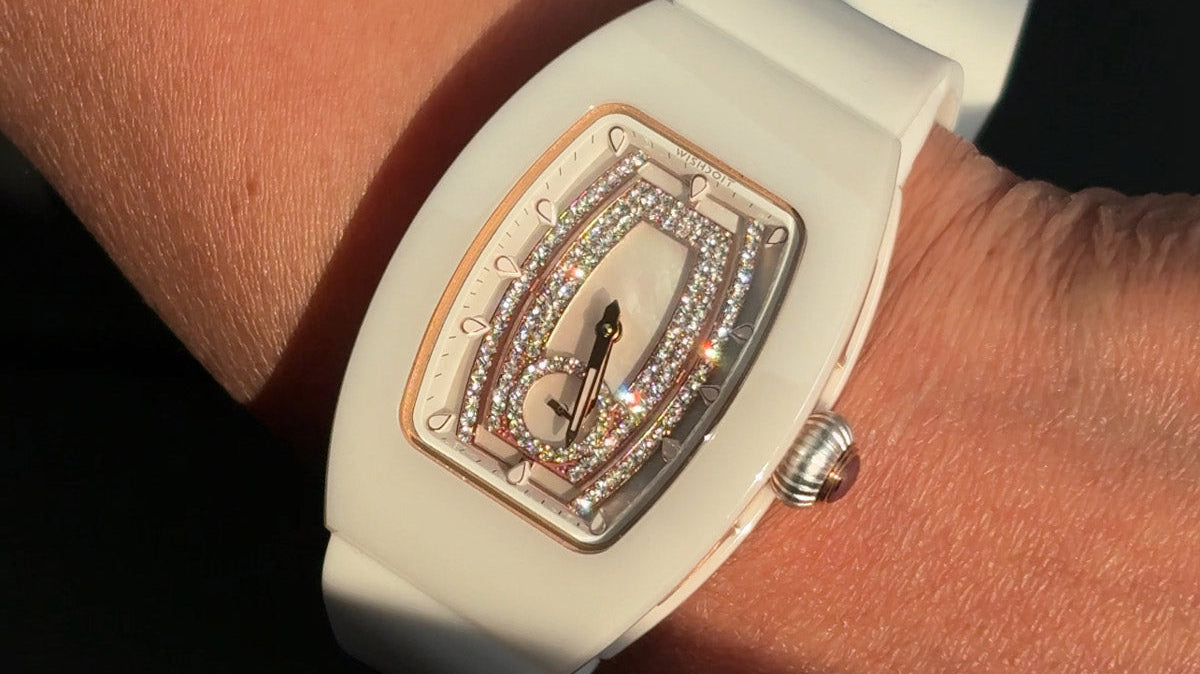


Celestia Ceramic Women’s Watch
$269

Ever looked at a watch with several small dials, extra buttons, and a large central hand that seems to do nothing? Those details aren't just for decoration. They may be part of a chronograph—a watch that combines everyday timekeeping with a built-in stopwatch.
Chronograph watches have a distinctive, instrument-inspired look, but their real appeal lies in how function and design work together. Whether you're timing a workout, tracking a cooking interval, or simply appreciating a more technical dial, understanding the chronograph makes choosing the right watch much easier.
So, what does a chronograph actually do? And what are those small dials telling you?
Let's break it down.
A chronograph is a watch with a built-in stopwatch function. It tells the current time like a regular watch, while also allowing you to measure elapsed time independently.
Think of it as two functions in one:
Timekeeping: Shows the current hour, minute, and sometimes seconds.
Chronograph timing: Measures how much time has passed after you start the timer.
Unlike a standard three-hand watch, a chronograph usually has additional pushers on the side of the case and one or more subdials on the main dial.
These features serve a purpose. The pushers control the timing function, while the subdials display measurements such as elapsed minutes, fractions of a second, or running seconds, depending on the movement.
Chronographs are often associated with motorsports, aviation, and sporting events, but you don't need to be a professional athlete or racing enthusiast to appreciate one. Today, they're also popular for their layered dials, mechanical-looking details, and confident wrist presence.

This is where many first-time buyers get confused. Three small dials may look similar, but they don't necessarily perform the same function.
There is no universal subdial layout. The function of each subdial depends on the movement inside the watch, so always check the manufacturer's specifications.
Here are the most common functions you'll encounter.
The small seconds subdial tracks the passing seconds during normal timekeeping.
On some chronographs, the large central seconds hand is reserved for stopwatch timing, while the small seconds hand continues moving to show the current time's seconds.
This explains why the large central hand may appear stationary when the chronograph isn't running. That can be completely normal.
The elapsed-minutes subdial records how many minutes have passed after you start the chronograph.
For example, if you start the timer and stop it after 12 minutes, the elapsed-minutes counter helps you read that duration.
Depending on the movement, the counter may measure up to 30 or 60 minutes, or use another interval. Check the markings on the dial to understand its range.
Some chronographs include a subdial that measures fractions of a second, such as tenths of a second.
This allows a more detailed reading of elapsed time than whole seconds alone. The exact display and operation depend on the movement used.
Some multifunction quartz watches include a 24-hour indicator. It typically follows the main time display to distinguish the current part of the day.
However, a 24-hour indicator is not automatically a chronograph counter. It may be a separate timekeeping function, even when it appears alongside stopwatch subdials.
The important lesson is simple: don't assume every small dial is a timer. Read the markings and product specifications before deciding what each one does.
Most traditional chronographs use pushers on the side of the case to control the stopwatch. The exact operation can vary by movement, but the usual sequence is straightforward.
Step 1: Start the timer.
Press the designated start/stop pusher. The chronograph hands or counters begin recording elapsed time.
Step 2: Stop the timer.
Press the same pusher again. The display stops so you can read the elapsed time.
Step 3: Read the result.
Use the central chronograph seconds hand and the relevant elapsed-time subdials together. The markings and movement determine how the reading should be interpreted.
Step 4: Reset the chronograph.
Once timing has stopped, press the reset pusher to return the chronograph hands to their starting positions.
Always follow your particular watch's instructions. Avoid forcing a pusher, and don't assume that every chronograph has the same control layout.
Chronographs can use either quartz or mechanical movements. Both can provide stopwatch functionality, but they work differently.
| Feature | Quartz chronograph | Mechanical chronograph |
|---|---|---|
| Power source | Battery | Wound mainspring |
| Timekeeping regulation | Electronic quartz oscillator | Mechanical balance and escapement |
| Operation | Electronic movement with timing circuitry | Mechanical components control the timing function |
| Maintenance | Periodic battery replacement and servicing as needed | Periodic mechanical servicing |
| Appeal | Practical, convenient timing | Traditional mechanical engineering and craftsmanship |
Neither type is automatically the better choice for everyone.
A quartz chronograph can be a sensible option if you want convenient everyday timekeeping and a practical stopwatch function. A mechanical chronograph may appeal more if you enjoy the engineering and traditional watchmaking behind a complex movement.
When comparing watches, consider how you'll use the chronograph, how much maintenance you're comfortable with, and which design you genuinely enjoy wearing.

A chronograph is functional, but it also changes the way a watch looks.
Multiple subdials create visual depth. Contrasting hands make the display feel more technical. Pushers add definition to the case, while tachymeter-style markings or racing-inspired details can reinforce the instrument aesthetic.
The result is a dial with more visual activity than a conventional three-hand watch.
But more detail isn't always better. A good chronograph should still be easy to read. Consider the contrast between the hands and dial, the clarity of the markings, the case size, and whether the subdials feel organized rather than crowded.
Case shape matters, too. A traditional round case offers a familiar silhouette, while an angular or tonneau-shaped case creates a more contemporary, assertive look.
For buyers who want a watch that combines practical timing with distinctive design, a chronograph can be an appealing everyday choice.
If you like the combination of stopwatch functionality and bold dial design, WISHDOIT's chronograph collection offers several racing-inspired options.
The RACING GT 2.0 combines a tonneau-shaped case with a multilayer racing-style dial and a Japanese Seiko quartz movement. Its 42 × 50 mm case, 316L stainless steel construction, and fluorine rubber strap give it a strong, contemporary presence.
The best choice depends on your wrist size, preferred colorway, and how you want the watch to fit into your wardrobe. Check each product page for the specific movement, timing functions, and case dimensions before ordering.
A chronograph makes sense if you want a watch that offers more than basic timekeeping.
Its stopwatch function can be useful for everyday tasks, while the additional subdials and pushers create a more technical appearance. Quartz models can also offer a convenient way to enjoy this functionality without the winding routine associated with mechanical watches.
Before buying, ask yourself three questions:
Will I use the timing function? If you regularly measure intervals, a chronograph may be genuinely useful.
Can I read the dial easily? A well-organized display is more practical than one that looks complicated but is difficult to interpret.
Does the design suit me? Case size, strap material, and dial layout matter just as much as the feature list.
A chronograph isn't essential for everyone. But if you appreciate useful complications and a more detailed watch design, it can be a worthwhile addition to your collection.
A chronograph watch combines ordinary timekeeping with a stopwatch function. Its subdials may track running seconds, elapsed minutes, fractions of a second, or other indicators, depending on the movement.
Once you understand what the counters do, a chronograph becomes much less intimidating. The extra hands and pushers aren't just decoration—they're part of a timing system designed to put more information on your wrist.
If you're looking for a watch with practical functionality and a distinctive, performance-inspired aesthetic, explore the WISHDOIT All Watches Collection and compare the available chronograph designs.
The right chronograph doesn't just measure time. It makes every second a little more interesting.
You'll also like:
Moon Pearl Is Here: The Celestia Watch Reimagined in Pearl-Like Elegance
Watch Water Resistance Explained: What Does 5 ATM Really Mean?
Watch Crown Care 101: Protect Your Watch’s Tiny but Mighty Control Center