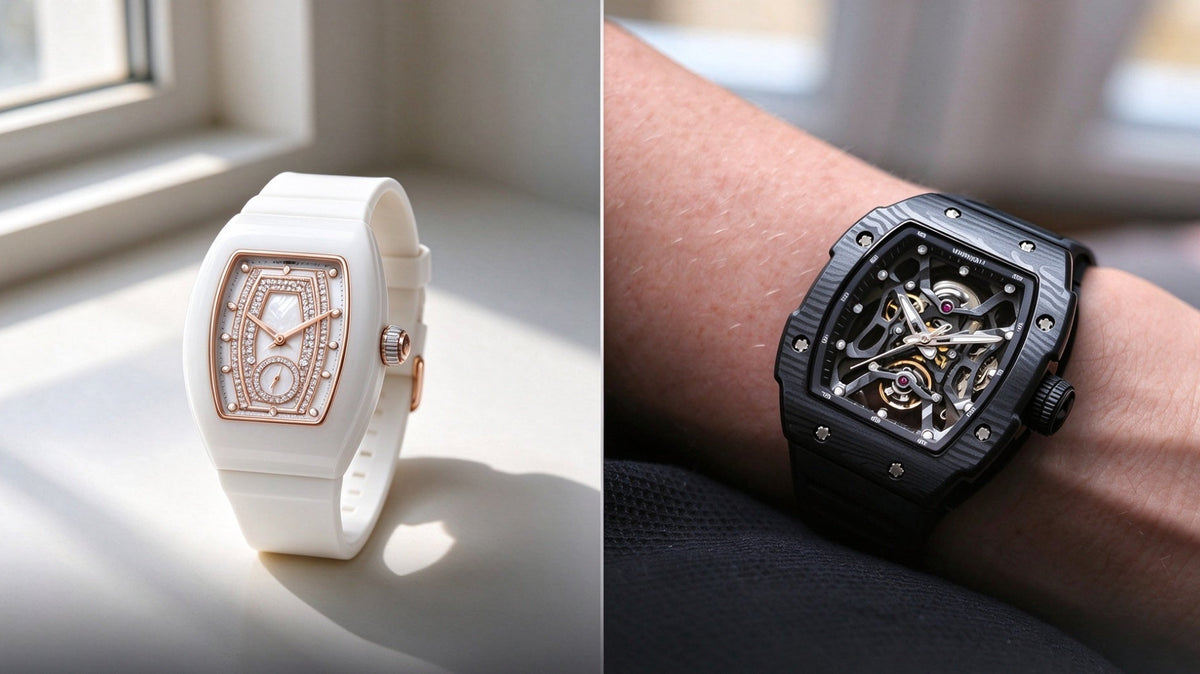


Celestia Ceramic Women’s Watch
$269

Thinking about buying a water-resistant watch? Before you take your watch into the water, here's what 5 ATM really means—and what it doesn't.
You see it everywhere on watch specifications:
5 ATM Water Resistance.
But what does it actually mean?
Does 5 ATM mean you can swim with your watch? Can you shower with it? And does “50 meters” really mean you can take your watch 50 meters underwater?
The short answer is: not exactly.
Understanding water resistance can help you choose the right watch—and, more importantly, protect the one you already own.
ATM stands for atmosphere, a unit used to describe pressure.
A watch rated at 5 ATM has been tested against pressure equivalent to approximately 50 meters of water under controlled laboratory conditions.
But here's the important part:
50 meters on the specification does not mean you should dive 50 meters underwater with your watch.
Real-world water exposure is different from laboratory pressure testing. Movement, water impact, temperature changes, and other conditions can affect how much stress the watch experiences.
That's why water-resistance ratings should be viewed as a guide—not a recommended diving depth.

No watch should simply be described as completely “waterproof.”
The more accurate term is water resistant.
According to Wishdoit's official FAQ, its watches have at least 5 ATM water resistance, which is intended for everyday exposure such as small amounts of water and splashes. Wishdoit specifically advises against general swimming and diving with 5 ATM watches.
So if your watch gets caught in the rain or comes into contact with a small amount of water, 5 ATM protection provides useful everyday resistance.
But that doesn't make it a dive watch.
For everyday wear, 5 ATM is a practical level of water resistance.
Generally, think:
Rain ✓
Hand washing ✓
Everyday splashes ✓
Swimming ✕
Diving ✕
Long periods underwater ✕
Wishdoit's policy explicitly states that 5 ATM water resistance is only for everyday wear and does not recommend wearing this watch while swimming or showering. The policy also warns that shower steam may make it easier for water to enter the watch.
This is important because water pressure is not the only factor to consider.
A common misconception is:
“If my watch is 5 ATM, why can't I shower with it?”
The problem isn't simply the depth of the water.
Hot water, steam, sudden temperature changes, and soap or chemicals can place additional stress on the watch's seals.
Over time, seals can also naturally deteriorate.
That's why even a water-resistant watch should be treated carefully.

Higher ratings generally provide greater protection against water pressure, but the exact suitability depends on the watch's construction and intended use.
As a simple guide:
| Rating | General Use |
|---|---|
| 3 ATM / 30M | Splash and rain protection |
| 5 ATM / 50M | Everyday water exposure |
| 10 ATM / 100M | Greater water resistance; check the manufacturer's activity guidance |
| 20 ATM / 200M | Designed for substantially greater water exposure; suitable use depends on the watch |
The key takeaway?
Don't choose a watch based on the number alone.
Always check the manufacturer's specific recommendations.
The crown is one of the most important points of entry for water.
Make sure it is properly pushed into its normal position before the watch comes into contact with water.
Avoid adjusting the time or using watch controls when the watch is wet.
This can compromise the seals and increase the risk of water entering the case.
Water resistance isn't necessarily permanent.
Gaskets and seals can deteriorate with age, and opening the case can affect water resistance if the watch isn't properly resealed.
For a mechanical or quartz watch you plan to keep for years, regular care matters just as much as the original water-resistance rating.
A 5 ATM watch isn't designed to be a diving instrument.
And that's completely fine.
For many people, a watch spends most of its life on the street, at work, traveling, or enjoying a weekend outdoors.
For that lifestyle, 5 ATM provides practical everyday water resistance without pretending to be something it isn't.
At Wishdoit Watches, water resistance is specified as part of each watch's technical information so customers can choose a model according to how they actually plan to wear it.
So, what does 5 ATM really mean?
It means your watch has been tested to withstand pressure equivalent to approximately 50 meters under controlled conditions—but it does not mean you should swim or dive 50 meters underwater with it.
The smartest approach is simple:
Know the rating. Follow the manufacturer's guidance. And don't confuse water resistance with waterproofing.
Because taking care of your watch isn't about avoiding water completely.
It's about understanding what your watch was designed to handle.
How to Prevent a Foggy Watch? Quick Solutions to Prevent Moisture Buildup
Are Wishdoit Watches Good? Materials, Specs & What You Get?
How Triton Prism Captures the Magic of the Ocean on Your Wrist