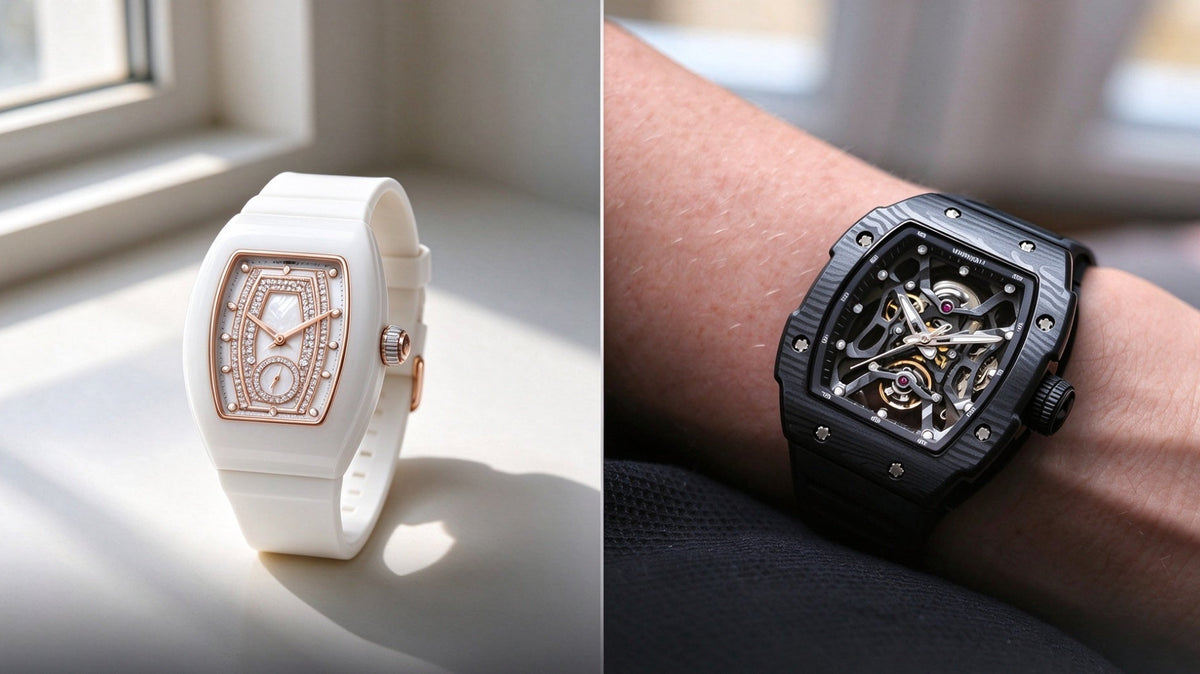


Celestia Ceramic Women’s Watch
$269

Changing the date on a watch looks simple.
Pull the crown. Turn it. Watch the number change. Push the crown back in.
Done.
But with a mechanical watch, when you make that adjustment can matter just as much as how you make it.
There is a period of the day when the watch's calendar mechanism may already be preparing to change the date automatically. Manually forcing the date during this period can put unnecessary stress on the mechanism.
This is one of those small details that most people never think about—until something goes wrong.
So before you adjust the date on your automatic watch again, there is one rule worth remembering:
Don't use the quick-set date function while the calendar mechanism is engaged.
Why?
Because during this period, the gears responsible for the automatic date change may already be moving into position.
Wishdoit's own instruction manual gives the same warning for its automatic GMT movement: never adjust the date or GMT hand between 9 PM and 3 AM, because the calendar mechanism is already engaging during this window.
Paul Rich also highlights the 9 PM–3 AM period as a time to avoid manual date adjustment on watches with a date complication.
The exact operating range can vary between movements, so your watch's specific manual should always take priority.
But as a simple everyday rule?
If you're unsure, set the date during the daytime.

A mechanical calendar is not just a printed number sitting behind the dial.
It is a small mechanical system connected to the movement.
As the watch approaches midnight, components inside the movement gradually engage the date-changing mechanism.
Depending on the movement, the date may change through a combination of gears, levers, springs, and a date wheel.
When the mechanism is already engaged, forcing the quick-set date function can make components work against each other.
That's the problem.
You're not simply moving a number.
You're manually interfering with a mechanical process that may already be underway.
And because these parts are tiny, forcing the crown is never a good idea.
Not necessarily.
One of the most dangerous assumptions with a mechanical watch is:
“The crown still turns, so everything must be fine.”
A crown turning doesn't mean that the movement is in the correct position for a date adjustment.
Mechanical watches don't always give you an obvious warning before an incorrect adjustment.
You may not hear a loud noise.
You may not immediately see damage.
The watch may even continue running normally.
That's why prevention matters more than trying to diagnose a problem afterward.
If your watch has a quick-set date function, use this simple method.
If you're not sure what time the watch is currently displaying, move the hands to a safe daytime position first.
A simple approach is to set the hands somewhere around 6 AM or 6 PM.
The important thing is that you're clearly outside the period when the calendar mechanism may be engaged.
Mechanical watches can have different crown positions for:
Manual winding
Date adjustment
Time adjustment
GMT adjustment
Don't assume every watch uses the same configuration.
For Wishdoit's ETERNAL EARTH GMT, the instruction manual identifies the first crown position for date/GMT adjustment and the second position for time adjustment.
Turn the crown according to your watch's instructions.
You should never need to use excessive force.
If the crown feels unusually tight or resistant:
Stop.
Don't force it.
Once the date is correct, adjust the hands to the actual time.
If you're setting a mechanical watch around midnight, pay attention to whether the date changes as you move the hour hand through 12.
This is also a useful way to determine whether the watch is displaying AM or PM correctly.
Once the adjustment is complete, return the crown to its normal position.
For watches with specific crown-locking requirements, follow the manufacturer's instructions.

Here's another common mistake.
You set the date correctly—but the date changes at noon instead of midnight.
Why?
Because the watch doesn't know whether you're setting AM or PM.
A mechanical watch simply follows the 12-hour cycle.
Here's an easy way to check:
Move the hour and minute hands forward slowly.
If the date changes as the hands pass 12, you've found the watch's midnight.
From there, continue setting the correct time.
This is particularly useful when restarting a mechanical watch that has stopped.
Don't panic.
The date-change mechanism doesn't necessarily have to switch the date at exactly 12:00:00.
Depending on the movement, the change may begin shortly before midnight, around midnight, or finish shortly afterward.
The important thing is whether the mechanism changes the date consistently and correctly.
If your watch normally changes the date a few minutes before or after midnight, that does not automatically mean there is a problem.
Consistency matters more than the exact second.
This is where people often panic.
If you accidentally used the quick-set date function during the danger period, don't immediately assume the movement is damaged.
Stop making further adjustments.
Return the watch to a safe operating position and observe it.
Check whether:
The date changes normally
The date advances correctly at midnight
The timekeeping remains normal
The crown continues to operate normally
If you notice unusual resistance, incorrect date changes, abnormal noises, or other problems, have the watch inspected by a qualified watchmaker.
The important thing is:
Don't keep forcing the mechanism to see if it “fixes itself.”
GMT watches require a little more attention because they can have additional time-zone functionality.
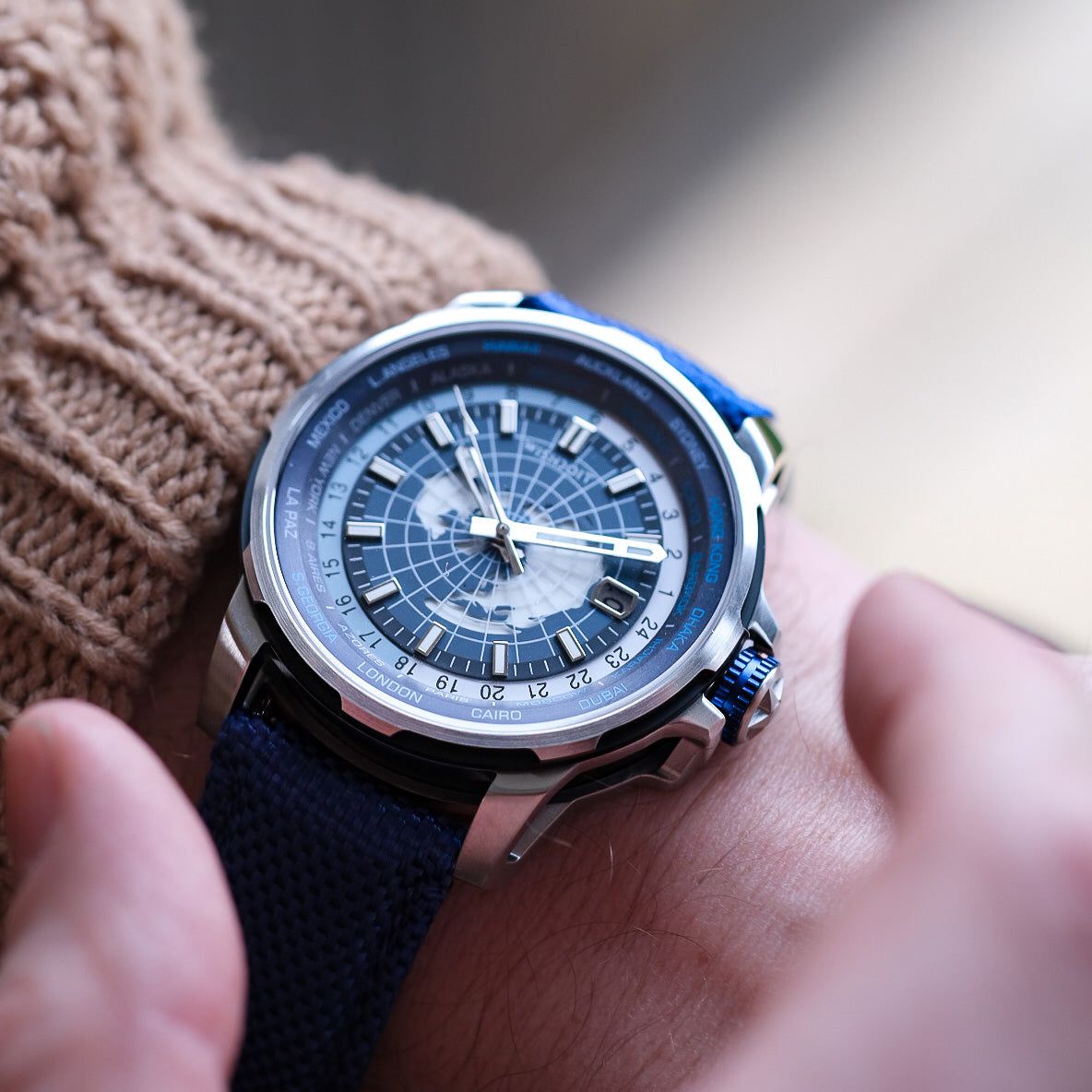
For example, the ETERNAL EARTH GMT Mechanical Watch uses an automatic GMT movement with an independently adjustable 24-hour hand. Wishdoit's instruction manual separates the crown positions for date/GMT adjustment and local-time adjustment.
That means there may be more than one setting to understand before you start turning the crown.
If you own a GMT watch:
Read the movement-specific instructions before adjusting the date or GMT hand.
This is especially important when travelling because you're more likely to be changing both the local time and the date.
The date window may look like a simple feature.
It isn't.
Behind that tiny number is another mechanical system working together with the rest of the movement.
The mainspring provides energy.
The gear train transfers it.
The escapement regulates it.
And the calendar mechanism uses that mechanical energy to advance the date.
That's one of the reasons automatic watches are so fascinating.
Even a simple date display can involve a surprisingly intricate chain of mechanical interactions.
Paul Rich's automatic-watch guide describes this broader principle: the mainspring releases stored energy through the gear train and escapement, while the balance regulates the movement.
There isn't a universal answer.
A date display gives you useful information without reaching for your phone.
For everyday wear, that can be genuinely convenient.
But a no-date dial can offer a cleaner, more symmetrical appearance.
When choosing a mechanical watch, think about how you actually use it.
Check the date frequently
Wear the same watch most days
Travel or work across different schedules
Prefer practical complications
Prefer minimalist dials
Want maximum visual symmetry
Rarely need to check the date
Prefer a simpler display
The important thing is understanding the mechanism—not choosing one simply because it sounds more complicated.
Wishdoit's current collection includes automatic mechanical watches in several different styles, including GMT, skeleton, tonneau, and classic mechanical designs. The current mechanical collection lists 11 automatic models and identifies date display, 24-hour display, power-reserve indicators, and other functions among the available features.
The ETERNAL EARTH GMT is the natural choice for someone who wants a date display together with GMT functionality.
Its world-inspired dial gives the watch a strong travel identity, while the GMT function adds practical second-time-zone functionality.
It is particularly suited to people who want their mechanical watch to do more than simply display hours and minutes.
The Aerial Prism takes a completely different direction.
Instead of making the calendar the visual focus, it puts the mechanical movement itself on display through its skeleton design.
The result is a watch for people who enjoy seeing the engineering rather than hiding it.
The Full Speed Tonneau Skeleton combines an automatic movement with a bold tonneau case and open-work dial.
It shows how a mechanical watch can move away from traditional round designs while keeping the mechanical character front and center.
Its appeal is less about one dramatic complication and more about the combination of mechanical movement, case design, and everyday wearability.
The GLACIER Starry Sky Automatic takes a more expressive approach to the dial.
It combines automatic mechanical functionality with a starry-sky-inspired visual concept, making the dial itself an important part of the experience.
These watches demonstrate an important point:
A mechanical watch doesn't need dozens of complications to be interesting.
Sometimes the movement, dial, proportions, and finishing are enough.
Before adjusting your mechanical watch's date, remember:
1. Check the time first.
If the hands are somewhere around the late evening or early morning, don't quick-set the date.
2. Move the hands to a safe daytime position.
When in doubt, use around 6 AM or 6 PM.
3. Use the correct crown position.
Check your specific watch manual.
4. Turn gently.
Never force a resistant crown.
5. Set AM/PM correctly.
Make sure the date changes at midnight, not noon.
6. For GMT watches, check the GMT instructions too.
Different movements use different adjustment systems.
7. If something feels wrong, stop.
Resistance is a reason to pause—not to apply more force.
A date window looks simple.
But inside a mechanical watch, it is part of a much larger system of gears, springs, and levers.
That's why one of the easiest ways to protect an automatic watch is also one of the simplest:
Don't adjust the date while the calendar mechanism may be engaged.
If you're unsure, move the hands to a safe daytime position first.
Use the correct crown position.
Turn gently.
And always follow the instructions for your specific movement.
Because owning a mechanical watch isn't just about appreciating how it looks on your wrist.
It's also about understanding what is happening underneath the dial.
And once you understand those small mechanical rules, your watch becomes more than an accessory.
It becomes a piece of engineering you know how to live with.
You'll also like:
Beyond the Wrist: 3 Unexpected Ways a Watch Can Define Your Signature Style
Why Ceramic Tonneau Watches Are Becoming a Modern Style Essential?
Watches as Investments: Which Timepieces Hold Their Value?