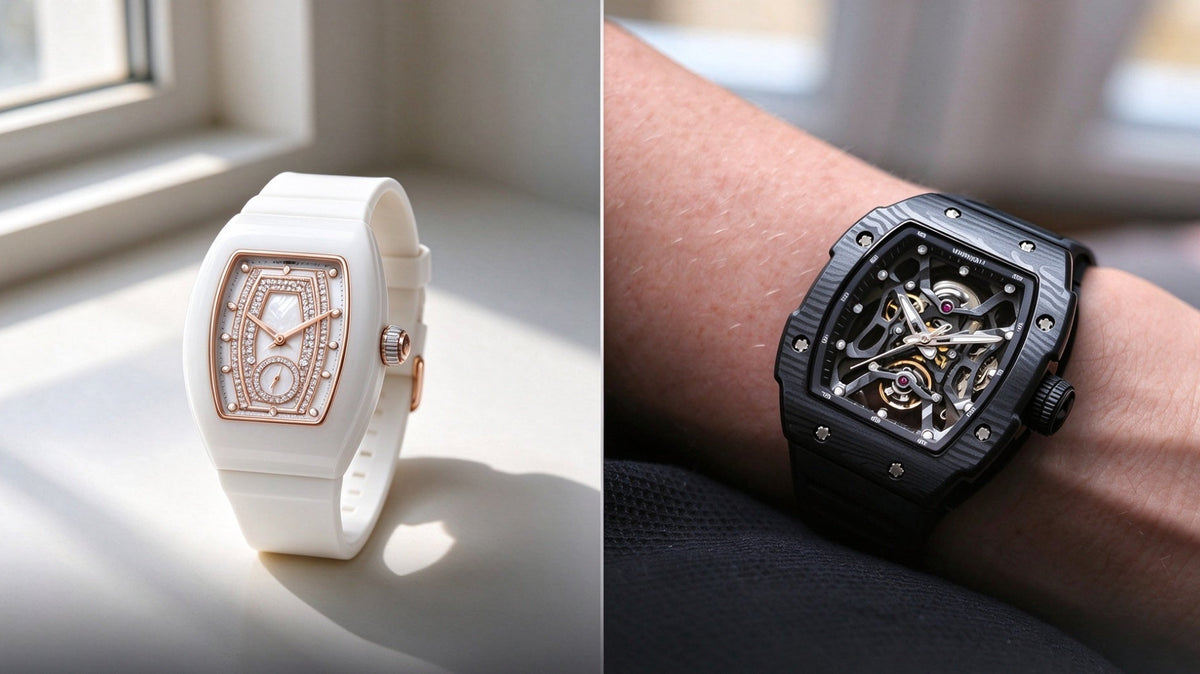


Celestia Ceramic Women’s Watch
$269

If you’ve ever shopped for a dive watch or a robust sports timepiece, you’ve likely seen water resistance ratings like 50M, 100M, or 150M stamped on the case back. It’s easy to assume that a watch marked “150M” is designed to accompany you on a 150-meter deep sea dive. However, in the world of horology, these numbers don’t translate directly to real-world diving depth. Understanding what they truly mean is key to caring for your watch—whether you own a reliable Wishdoit watch or are considering adding one to your collection.
This guide will clarify the science behind water resistance ratings and explain how a watch like a Wishdoit watch is engineered for aquatic adventures.

Water resistance ratings are determined under controlled, static laboratory conditions. When a watch is tested to 150 meters, it means it can withstand the equivalent static pressure of a 150-meter column of water—without any movement, temperature change, or additional forces acting upon it.
In reality, when you dive or even swim, you create dynamic pressure. Your movements—arm strokes, kicking, changes in orientation—significantly increase the force exerted on the watch. Therefore, the actual safe depth for active use is considerably less than the stated rating.
This is why international standards, such as ISO 6425 for dive watches, require that a watch rated for 150 meters of water resistance must actually be tested to 125% of its rating (or 187.5 meters) to ensure safety under real dynamic conditions.
Here’s a practical translation of common ratings for everyday wear and aquatic activities:
30M / 3 ATM: Splash-resistant. Suitable for hand washing or rain, but not for swimming.
50M / 5 ATM: Suitable for showering, swimming in a pool, and light snorkeling—but not for diving or high-impact water sports.

100M / 10 ATM: Appropriate for recreational swimming, snorkeling, and most water sports.
150M / 15 ATM: This is the true beginning of dive-capable territory. A Wishdoit watch with a 150M rating is designed for recreational scuba diving—not at 150 meters, but typically at depths recommended for non-decompression diving, usually up to 40 meters (130 feet). This is the standard for most serious dive watches, including many models in the Wishdoit watches collection.
200M+ / 20ATM+: Professional dive territory, suitable for deeper technical diving.
So, if you own a Wishdoit watch rated at 150M, you can confidently take it snorkeling, swimming, and on recreational dives to standard depths—but it is not engineered for a 150-meter deep dive.
Achieving a 150M rating requires meticulous engineering. Key features found in a water-resistant Wishdoit watch include:
Screw-Down Crown: This is essential. The crown screws into the case tube, creating a watertight seal that prevents water from entering through the winding stem.
Screw-Down Case Back: Similarly, the case back is screwed and sealed with a gasket, rather than simply pressed on.
Robust Gaskets: Synthetic rubber or silicone gaskets are used at all potential entry points, including the crown, case back, and crystal. These degrade over time, which is why periodic pressure testing is recommended.
Thick, Sealed Crystal: The watch glass—often made of sapphire or mineral crystal—is firmly seated and sealed to the case.
Helium Escape Valve (on some professional models): For saturation diving, though this is not typically needed for 150M-rated watches.
It’s this multi-layered approach to sealing that allows a Wishdoit watch to earn its water resistance rating.
A rating is not a permanent guarantee. Several factors can reduce a watch’s water resistance over time:
Gasket Degradation: Over time, gaskets can dry out, crack, or become misshapen.
Temperature Shock: Jumping into cold water with a warm watch (or vice versa) can cause temporary seal contraction or expansion.
Impact Damage: A knock to the crown or case can misalign components and break the seal.
Crown Left Unscrewed: Forgetting to screw down the crown after setting the time or date is a common cause of water damage.
This is why it’s recommended to have your Wishdoit watch pressure tested annually if you frequently expose it to water, and to always ensure the crown is fully secured before any aquatic activity.
A 150M water resistance rating on a Wishdoit watch is a mark of serious engineering and robust construction. It tells you that the watch is built to handle the dynamic pressures of active water use—be it swimming, snorkeling, or recreational diving. However, it is a rating of capability under test conditions, not an invitation for extreme-depth exploration.
By understanding what the number truly represents, you can enjoy your Wishdoit watch with confidence in its durability, while also caring for it in a way that ensures its longevity. Whether you’re poolside or exploring a coral reef, your watch is designed to be a reliable companion—just within the sensible limits that protect both you and its intricate mechanics.
Explore the collection of Wishdoit watches to find a timepiece that matches your lifestyle, from everyday resilience to aquatic-ready performance.
How to Replace a Watch Battery: Detailed Steps
What Makes a Good Watch? A Guide to Choosing the Right Timepiece
Seize the Moment: Why "Do It Now" Is the Perfect Motto for Your Watch (and Life!)