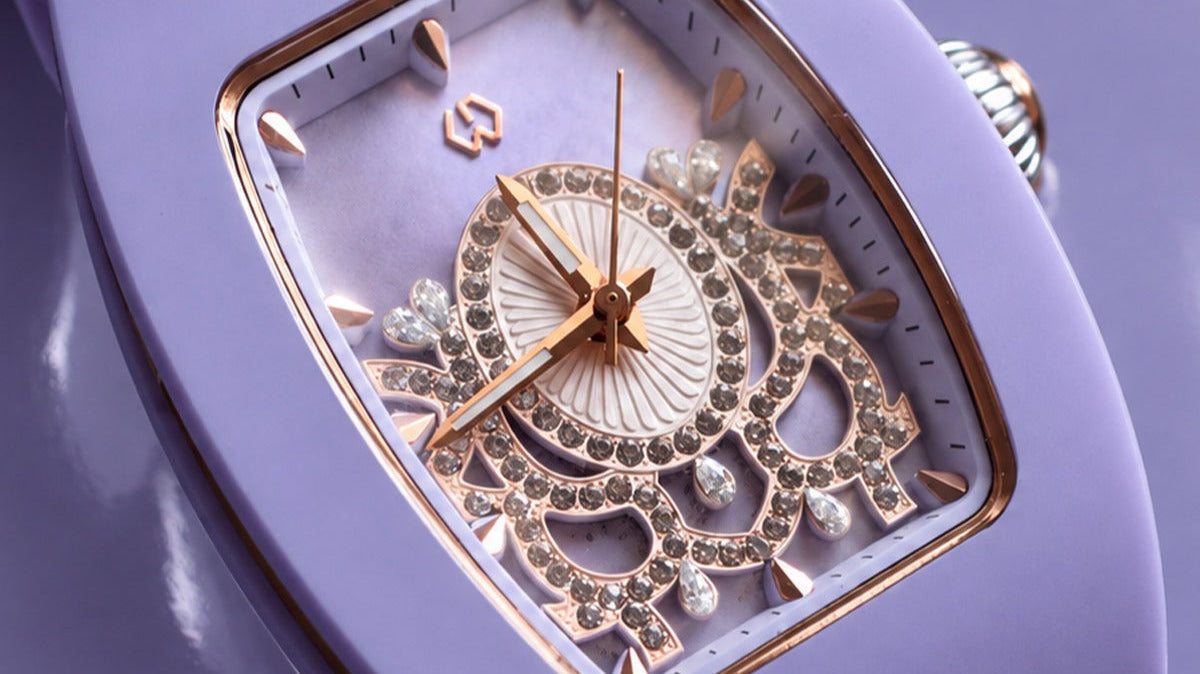


Celestia Ceramic Women’s Watch
$269

Have you ever checked your watch in the morning, only to discover that it is already several seconds ahead or behind? At first, it might not seem like a big deal. But when those seconds gradually turn into minutes, you may start wondering: Is my watch broken?
The answer isn't always yes.
Every watch has an acceptable margin of error, and the expected accuracy depends largely on its movement. Mechanical watches naturally gain or lose time because of their intricate internal mechanisms, while quartz watches are generally much more precise.
However, if your watch suddenly starts running significantly faster or slower than usual, the cause may have more to do with how you wear, store, or maintain it than with a defective movement.
In this guide, WishDoit explains what daily watch accuracy really means, how many seconds are considered normal, and what you should check before assuming your watch needs repair.
The first thing to understand is that mechanical and quartz watches have very different accuracy standards.
Mechanical watches rely on a mainspring, balance wheel, hairspring, and a series of gears to measure time. Because these components work together mechanically, small variations in their movement can affect accuracy.
For many standard, non-chronometer mechanical movements, a daily deviation of approximately -20 to +40 seconds can fall within the manufacturer's specified tolerance. Some movements perform considerably better.
Here is a general reference:
| Daily deviation | What it may indicate |
|---|---|
| ±5 seconds | Very good accuracy |
| ±10 seconds | Good accuracy |
| ±20 seconds | Generally reasonable for many mechanical movements |
| ±30–40 seconds | May still be within certain movement specifications |
| More than 40 seconds | Worth investigating against the movement's specifications |
| Several minutes | Not typical and deserves attention |
These figures are general guidelines, not universal standards. Always check the specifications of your particular movement.
For example, some WishDoit automatic watches use the Miyota 8215 movement, whose manufacturer's stated accuracy range is -20 to +40 seconds per day.
This means that a small daily difference does not automatically indicate a defect.

Quartz watches operate differently. A battery supplies energy to a quartz crystal, which vibrates at a stable frequency and helps regulate timekeeping.
As a result, quartz movements are generally much more accurate than mechanical movements.
A typical quartz watch may have an accuracy specification of approximately ±15–20 seconds per month, although the exact figure depends on the movement.
If a quartz watch consistently loses or gains several seconds every day, it is worth checking the battery, movement, and other possible causes.
The key takeaway: A mechanical watch should be evaluated according to its daily-rate specification, while a quartz watch should generally be judged against its monthly accuracy specification.
One of the most common mistakes watch owners make is assuming that a single day's deviation tells the whole story.
For mechanical watches, daily accuracy can change depending on several conditions:
How fully the mainspring is wound.
How long the watch is worn each day.
The position in which the watch rests overnight.
Changes in temperature.
Exposure to external magnetic fields.
For this reason, it is better to monitor your watch over seven consecutive days rather than drawing conclusions from a single 24-hour period.
You don't need professional equipment to perform a basic accuracy check.
Follow these simple steps:
Step 1: Synchronize Your Watch
Set your watch against a reliable reference clock, such as an atomic-time service.
Step 2: Record the Starting Time
Write down the exact time when you synchronize your watch.
Step 3: Wear It Normally
Use your watch according to your usual daily routine. Avoid deliberately changing your wearing habits during the test.
Step 4: Check It at the Same Time Each Day
After 24 hours, compare your watch with the reference clock and record the difference.
Step 5: Repeat for Seven Days
Calculate the total gain or loss and divide it by seven.
For example:
Day 1: +8 seconds
Day 2: +11 seconds
Day 3: +9 seconds
Day 4: +10 seconds
Day 5: +12 seconds
Day 6: +9 seconds
Day 7: +11 seconds
Total deviation: +70 seconds.
Average daily deviation: +10 seconds per day.
This is a much more useful measurement than judging your watch based on one isolated reading.
If your watch consistently exceeds its expected accuracy range, don't immediately assume that the movement is defective.
Several everyday factors can affect its performance.
This is one of the most overlooked causes of abnormal mechanical watch accuracy.
Everyday objects such as magnetic phone accessories, speakers, magnetic clasps, and certain electronic equipment can expose a watch to magnetic fields.
Mechanical watches contain delicate components, particularly the hairspring, that can be affected by magnetism.
When the hairspring becomes magnetized, its coils may stick together, changing the balance wheel's behavior. This can cause the watch to run unusually fast.
What should you do?
If your mechanical watch suddenly starts gaining a significant amount of time, consider having it checked for magnetism.
A watch demagnetizer can help remove unwanted magnetism when used correctly. If you are unfamiliar with the process, a professional watchmaker can perform the procedure safely.
Automatic watches generate energy through the movement of your wrist, which winds the mainspring.
If you spend most of your day sitting still or leave your watch unworn for extended periods, the mainspring may not receive sufficient winding.
When the stored energy becomes low, the movement may no longer operate under its ideal conditions, potentially affecting accuracy.
What should you do?
Follow your movement's manual for the recommended winding procedure.
Wear your automatic watch regularly.
If it has stopped, wind it according to the manufacturer's instructions before evaluating its accuracy.
Avoid assuming that a low power reserve automatically means the movement is damaged.
Mechanical movements contain numerous small metal components.
Changes in temperature can affect the dimensions and behavior of these components, including the hairspring and balance assembly.
As a result, a watch may perform differently in hot and cold environments.
For example, leaving your watch in direct sunlight, inside a hot car, or near a heating source for extended periods is not recommended.
What should you do?
Store your watch in a stable, moderate-temperature environment. Avoid exposing it to sudden or extreme temperature changes.
Have you noticed that your watch seems to gain time when you wear it but loses time when you leave it on your bedside table?
This can happen because gravity affects the balance assembly differently depending on the watch's position.
A mechanical watch may perform differently when placed dial-up, dial-down, or vertically with the crown facing upward.
What should you do?
Try recording your watch's accuracy in different resting positions overnight.
Over time, you may discover a position that helps compensate for its natural daily deviation.
Mechanical movements contain many moving components that require appropriate lubrication.
As time passes, lubricants can deteriorate, dry out, or become less effective.
This may increase friction between components and affect the movement's performance.
If your watch has been used for several years without maintenance and its accuracy has gradually deteriorated, it may be time for a professional inspection.

A watch that gains or loses a few seconds every day is not necessarily a problem.
What matters more is whether the deviation is consistent, whether it falls within the movement's specifications, and whether its performance has changed suddenly.
Here are some situations worth paying attention to:
Situation 1: Your Watch Gains Several Minutes Every Day
This is not typical for a normally functioning mechanical watch. Magnetism should be one of the first things to investigate.
Situation 2: Your Watch Suddenly Starts Losing Significant Time
Check the winding level and wearing habits. If the problem continues, the movement may need professional inspection.
Situation 3: Your Watch Stops Unexpectedly
For an automatic watch, insufficient winding may be the cause. If the watch stops despite adequate winding, further inspection is recommended.
Situation 4: Your Watch's Accuracy Gradually Gets Worse
Aging lubricants, internal wear, or other mechanical issues may be responsible.
If your watch consistently operates outside its manufacturer's stated tolerance, contact the seller or a qualified watchmaker for advice.
A well-maintained watch can provide reliable timekeeping for years. A few simple habits can help protect its performance.
Keep automatic watches sufficiently wound: Follow the recommended winding instructions for your movement.
Avoid strong magnetic fields: Keep your watch away from magnetic accessories and equipment.
Store it properly: Choose a clean, dry location away from extreme temperatures.
Handle the crown carefully: Avoid forcing it when setting the time or date.
Monitor its accuracy: Record daily deviations periodically to identify unusual changes.
Arrange professional maintenance: If performance deteriorates or the watch develops an abnormal behavior, seek professional assistance.
At Wishdoit, we believe that understanding your watch is an important part of enjoying it. Whether you prefer the intricate mechanics of an automatic skeleton watch, the distinctive appearance of a GMT timepiece, or the everyday convenience of a quartz chronograph, knowing how your movement works helps you get more from your watch.
Explore theWishdoit Watch Collection and discover a timepiece that matches your style.
So, how many seconds a day is normal for a watch?
For many standard mechanical watches, a deviation of around -20 to +40 seconds per day may be within the movement's specifications. Quartz watches generally offer much higher accuracy, often measured in seconds per month.
But if your watch suddenly starts gaining minutes, losing significant time, or behaving differently from before, don't immediately blame the movement.
Magnetism, insufficient winding, temperature changes, wearing habits, and maintenance can all play a role.
Before deciding that your watch is broken, take a few days to observe its performance and investigate the possible causes.
A good watch isn't just about keeping time. It's also about understanding the craftsmanship behind every second.
Keep your WishDoit timepiece properly maintained, and enjoy every moment it accompanies you.
Can Setting the Date Damage Your Watch? The Time Zone 90% of Watch Owners Ignore
How to Prevent a Foggy Watch? Quick Solutions to Prevent Moisture Buildup
Swiss, Japanese, or Something Else? Debunking the Myth of the "Best" Watch Movement