

Celestia Ceramic Women’s Watch
$269

A ceramic watch and a skeleton watch can share the same tonneau silhouette—the barrel-shaped case that sits a little longer than it is wide—and still be very different watches. In Wishdoit’s current catalog, that is exactly the situation.
Today’s ceramic vs skeleton choice is not a material swap on one design. The current ceramic tonneau watches are mainly compact, jewelry-leaning women’s quartz pieces at 31 mm. The current skeleton tonneau watches are mainly larger, open-worked men’s automatic pieces at about 42 mm. If you are deciding between them—for yourself, or after reading our guide to choosing a watch as a gift—the useful question is not “which finish looks nicer in a photo.” It is which kind of watch actually fits the wearer, the wrist, and the way it will be used.

It is easy to treat “ceramic vs skeleton tonneau” as a style preference. On the current Wishdoit line, size and intended wearer change at the same time as the material and the dial.
The ceramic side is a family of 31 mm women’s watches: Celestia, Pearl Bloom, Peacock Plume, and ChronoOwl. They share a ceramic tonneau case that is 31 mm across and 12 mm thick, a fluorine rubber (FKM) strap of 18 mm × 18 cm, and a weight of about 70 g. They are jewelry-leaning everyday watches, not scaled-down versions of the men’s skeleton models.
The skeleton side is a family of larger mechanical watches for a men’s wrist: Aerial Prism, The Runway, and Snow Leopard. Each uses a 316L stainless-steel tonneau case measuring 42 mm × 50 mm × 14.8 mm, with a 25 mm × 21 cm FKM strap. Aerial Prism and The Runway are about 135 g; Snow Leopard is about 127 g. That is roughly twice the case width of the ceramic line, and nearly twice the weight.
If the wearer has a smaller wrist or wants a light, jewelry-like watch, the ceramic tonneau is the realistic starting point. If the wearer wants a mechanical presence and can comfortably wear a 42 mm × 50 mm case, the skeleton tonneau is the better match. Trying to “convert” one into the other by focusing only on ceramic or only on an open dial usually leads to the wrong size.
Both families use the same barrel-shaped case language, which is why they can look related in a product grid. Up close, they present very differently.
A ceramic tonneau is smooth, closed, and often jewelry-like. The case material itself is part of the design: a polished ceramic surface with a compact profile. The dials stay relatively quiet as timekeepers and do their distinctive work through color and detail—Celestia as everyday elegance, Pearl Bloom with floral zircon accents, Peacock Plume with a peacock-inspired motif, and ChronoOwl with a starry dial and sculpted owl details. (Where these watches use zircon, that is zircon, not a diamond.) ChronoOwl’s name can sound sporty, but it is a three-hand quartz watch, not a rugged chronograph.
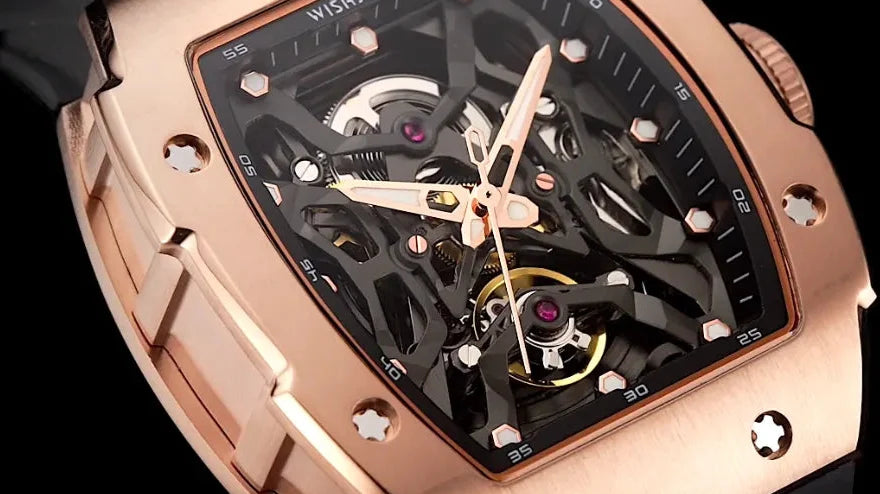
A skeleton tonneau is built to show the movement. The open-worked dial is the point: gears, bridges, and luminous accents sit in view, so the watch has more visual depth and a stronger mechanical presence on the wrist. Aerial Prism is the clearest everyday example of that architecture. The Runway uses the same skeleton tonneau language with an extended power reserve. Snow Leopard adds zircon accents for a brighter, more ornamental mechanical look—again, zircon, not a diamond. If you want a fuller explanation of open-worked dials, see What Is a Skeleton Watch? rather than repeating that primer here.
A practical way to decide: if you want the watch to read as a refined accessory, ceramic is usually the better presence. If you want people to notice the movement and the depth of the dial, choose skeleton.
Comfort follows the measurements more than the marketing language. The numbers below come from the current official specifications; they are the most reliable way to imagine the watch on a wrist.
| Current ceramic tonneau line | Current skeleton tonneau line | |
|---|---|---|
| Typical wearer | Women’s / jewelry-leaning | Men’s mechanical |
| Case | Ceramic tonneau, 31 mm × 12 mm | 316L steel tonneau, 42 mm × 50 mm × 14.8 mm |
| Weight | About 70 g | About 127–135 g |
| Strap | FKM, 18 mm × 18 cm | FKM, 25 mm × 21 cm |
| Crystal | Sapphire-coated mineral crystal | Sapphire-coated mineral crystal |
| Water resistance | 5 ATM, everyday splash | 5 ATM, everyday splash |
| Movement | MIYOTA Japanese quartz | Automatic mechanical, 21 jewels |
| Power or battery | Battery life about 3 years | 48 hours (Aerial Prism) or 80 hours (The Runway, Snow Leopard) |
Two details are easy to miss. First, the skeleton case is listed as 42 mm × 50 mm, not a round 42 mm. The extra length of the tonneau is part of how it wears; it will look longer on the wrist than a 42 mm round watch. Second, both lines use a sapphire-coated mineral crystal, not a full sapphire crystal. The coating improves scratch resistance compared with plain mineral glass, but it is not the same as a sapphire crystal throughout.
If you already know the wearer has a slim wrist, or that they prefer light jewelry, the 31 mm ceramic case is the comfortable choice. If they already wear larger watches, or they want a substantial mechanical piece, the 42 mm × 50 mm skeleton is the one that will feel in proportion. An adjustable FKM strap helps with length; it cannot shrink a case that is already too wide.
The current ceramic line is quartz. The current skeleton line is automatic mechanical. That is another reason this is not a same-watch comparison.
A MIYOTA Japanese quartz movement, as used in Celestia, Pearl Bloom, Peacock Plume, and ChronoOwl, is the easier daily companion. You set it, wear it, and put it down without thinking about winding. The official specification for these models lists a battery life of about three years. When the battery eventually needs replacing, that is ordinary quartz maintenance—not a reason to avoid the watch.
An automatic skeleton asks for a little more participation, and it offers a different kind of pleasure in return. Aerial Prism, The Runway, and Snow Leopard use an automatic mechanical movement with 21 jewels, beating at 28,800 vibrations per hour (4.0 Hz). Wear the watch and the motion of the wrist winds it; if it sits unused, you can wind it according to the product instructions and set the time again. The useful difference inside this group is the power reserve: Aerial Prism is specified at 48 hours, while The Runway and Snow Leopard are specified at 80 hours. If the watch may spend a weekend off the wrist, the longer reserve is the more forgiving option.

Choose quartz if you want the watch to be ready every morning with almost no thought. Choose automatic if the wearer will enjoy seeing the movement, wearing it often enough to keep it running, and occasionally winding it after a pause. Neither is a lesser choice when it matches how the watch will actually be used.
Both lines are built for daily wear, with the same official water-resistance rating: 5 ATM. On these watches, that means everyday splash resistance and brief contact with water under test conditions. It does not mean the watch is for swimming, showering, or diving, and the crown should not be operated while wet.
Ceramic is hard and holds a polished surface well, but it still benefits from simple habits: wipe it with a soft cloth, avoid harsh cleaners, and be thoughtful about knocks against hard edges. For a practical routine, use How to Care for a Ceramic Watch.
A skeleton watch is not fragile theater, but the open dial does make cleanliness and sensible wear more visible. Keep the crystal reasonably clean so the movement stays easy to read, avoid unnecessary shocks, and treat water with the same 5 ATM limit as the ceramic line. If an automatic watch stops after it has been left unworn past its power reserve, that is expected behavior—not a defect. Wind it, set the time, and wear it again.
Both families include a 2-Year Warranty. What’s included with the watch is the watch and original packaging.

Choose a ceramic tonneau if the watch should move from work to dinner as a refined accessory. Celestia is the most straightforward everyday-elegant option. Pearl Bloom or Peacock Plume will suit someone who wants a more jewelry-like dial. ChronoOwl is for a wearer who likes a starry, characterful dial without a sport-chronograph case. These are natural matches for smaller wrists, lighter clothing, and people who want a watch that behaves like jewelry they can wear every day. You can compare those four in more detail in How to Choose a Women’s Ceramic Tonneau Watch.
Choose a skeleton tonneau if the watch should feel like a mechanical object, not only an accessory. Aerial Prism is the everyday skeleton starting point, with a 48-hour reserve. The Runway is the closer match when a longer 80-hour reserve matters. Snow Leopard is the more ornamental mechanical option, with zircon accents on the same 42 mm × 50 mm automatic platform. These watches suit a larger wrist, a wearer who likes an open dial, and days when a stronger presence is welcome—office included, if the rest of the wardrobe can carry it.
Price is a factual part of the same decision, not a reason to force a match. The current ceramic quartz models are $269. Aerial Prism and The Runway are $469; Snow Leopard is $499. That difference tracks the movement type and case size; it does not turn one line into a substitute for the other.
If you are buying for someone else, use this size-and-style split first, then refer back to the gift-buying framework for wrist-size clues and what to mention when you give the watch. This article is about choosing the type of watch, not about wrapping it.
If you are still torn, walk through the questions in order:
If those answers point clearly to one column in the table above, you already have your conclusion. The individual model is a refinement after that.
In this catalog, the difference is bigger than the dial. A current ceramic tonneau is a 31 mm women’s quartz watch with a smooth ceramic case and a closed, often jewelry-like look. A current skeleton tonneau is a larger, 42 mm × 50 mm men’s automatic watch with an open-worked dial that shows the movement. A ceramic vs skeleton watch decision is therefore about size, wearer, movement, and presence together—not only about case material.
No. The current ceramic tonneau watches measure 31 mm across and 12 mm thick and weigh about 70 g. The current skeleton tonneau watches measure 42 mm × 50 mm × 14.8 mm and weigh about 127–135 g. They are not a same-size option in a different material.
Start with the wrist and the look you want, then confirm the movement you are willing to live with. Choose ceramic if you want a light, compact, jewelry-leaning quartz watch for everyday wear. Choose skeleton if you want a larger automatic watch with an open mechanical dial and are comfortable wearing or winding it. Use the checklist above, and only then compare models such as Celestia or Pearl Bloom on the ceramic side, and Aerial Prism, The Runway, or Snow Leopard on the skeleton side.
On the current Wishdoit ceramic and skeleton tonneau lines, yes: the ceramic models use a MIYOTA Japanese quartz movement, and the skeleton models use an automatic mechanical movement. That is a description of what is in the catalog today, not a universal rule for every watch brand.
No. Both the ceramic and skeleton models discussed here are rated 5 ATM, which is intended for everyday splashes, not swimming, showering, or diving.
If you want a compact, polished watch that feels close to jewelry and asks almost nothing of you day to day, choose a ceramic tonneau from the current women’s watches line. If you want a larger mechanical watch with an open dial and a stronger presence, choose a skeleton tonneau from the current men’s watches and skeleton watches collections. You can also browse both families together in the tonneau watch collection, then let the size, the movement, and the look—not a side-by-side illusion of sameness—settle the decision.