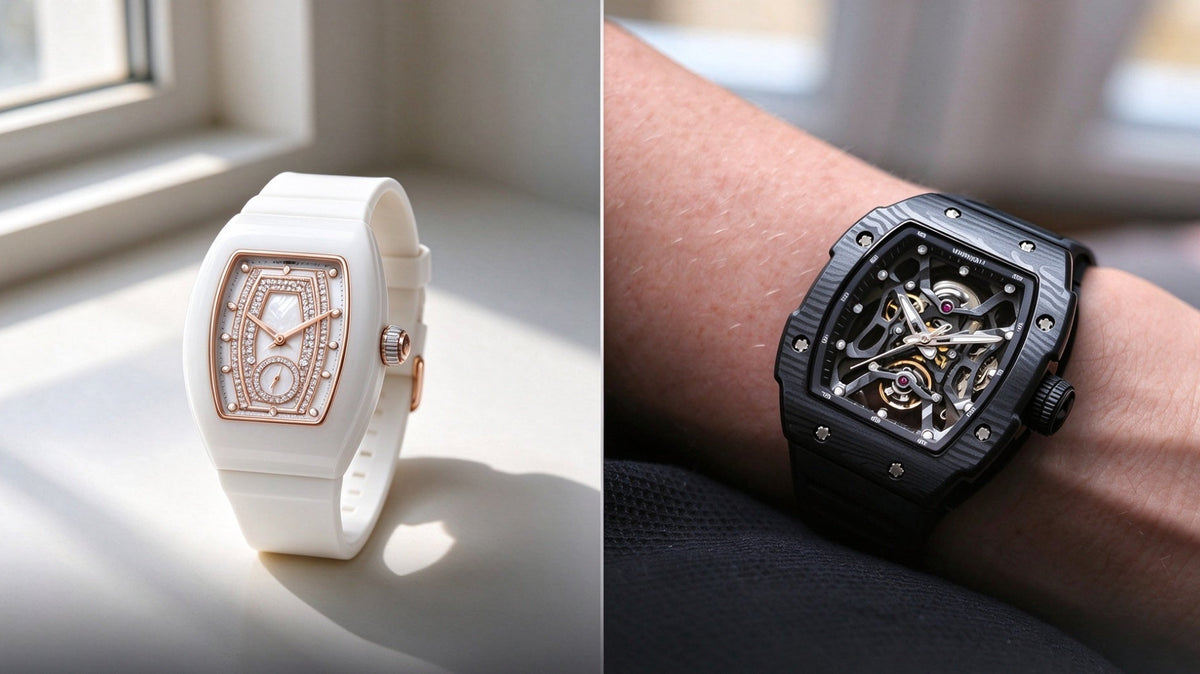


Celestia Ceramic Women’s Watch
$269

In the world of mechanical watches, the method by which a watch is wound—whether by the motion of your wrist or the turn of your fingers—fundamentally shapes its character and how you interact with it. A common question among enthusiasts is: which system holds power longer? The answer isn't as straightforward as it seems, as it hinges on engineering, daily habits, and the specific design philosophy behind the timepiece. Let's wind through the mechanics and myths, with a look at how this plays out in the versatile collections of Wishdoit watches.

First, it's essential to understand the source of power.
Manual Winding: The user directly winds the mainspring by turning the crown. This tightens the spring, storing potential energy that is gradually released to power the movement. The power reserve ends when this stored energy is fully spent.
Automatic Winding: Also known as self-winding, this system features a semi-circular rotor that swings with the motion of the wearer's wrist. This rotor winds the mainspring via a series of gears. An automatic watch is essentially a manual-winding movement with this ingenious add-on module.
At their core, the maximum power reserve of a movement is determined by the design and capacity of its mainspring barrel, not by its winding method. A well-designed manual movement and its automatic counterpart, based on the same base caliber, will often have a very similar theoretical power reserve.
For instance, many modern mechanical movements, whether manual or automatic, offer power reserves in the range of 38 to 80 hours. You can find a Wishdoit watch with a precise manual-wind movement that lasts 72 hours sitting right next to an automatic Wishdoit watch from the same family with a 70-hour reserve. The difference is negligible from a specification sheet perspective.
This is where daily reality intervenes. While the potential energy storage is similar, the practical power retention often favors the automatic—but with a major caveat.
For the Daily Wearer: If you wear your automatic Wishdoit watch regularly, it will constantly top itself up, effectively holding power indefinitely as long as it's on your moving wrist. It's nearly impossible to "over-wind" a modern automatic, as they have a slipping clutch mechanism to prevent it. In this common scenario, the automatic system holds usable power far longer.
For the Occasional Wearer: If you rotate your watches frequently or don't wear a watch every day, the story changes. Once taken off, an automatic watch will simply run until its reserve is depleted. A manual-wind watch in the same scenario requires a conscious winding ritual to reach its full reserve. Here, neither has an inherent advantage in hold time—both will stop when their spring unwinds.

The manual winder’s strength isn't in duration, but in predictability and interaction.
Full Charge, Every Time: When you wind a manual Wishdoit watch 30 times, you know it has reached its maximum, consistent power reserve. There's no dependency on how much you walked that day.
No "Stalling" from Inactivity: An automatic watch that hasn't been worn enough may stop on the wrist if its reserve was empty. A manually wound watch starts with full power.
The Ritual: For many, the daily or every-other-day act of winding is a cherished, mindful connection to their timepiece. This tactile experience is a signature pleasure of owning a manual-wind watch from any collection, including Wishdoit watches.
Your lifestyle dictates the winner in this debate.
Choose an Automatic Wishdoit watch if: You wear a watch daily and prefer "set-it-and-forget-it" convenience. It's the ideal companion for consistent, active wear, effectively offering a limitless power supply as long as it's on your wrist.
Choose a Manual-Winding Wishdoit watch if: You appreciate horological ritual, often rotate your watches, or seek a slimmer case profile (manual movements can be thinner). It offers total control and a guaranteed full reserve whenever you put it on.
So, which holds power longer? In a drawer, they are equal. On a consistently active wrist, the automatic wins by maintaining its charge. However, reducing these mechanisms to mere power metrics misses their soul.
Automatic winding offers modern, effortless perpetuity. Manual winding offers timeless, intentional connection. Both are celebrated in the world of Wishdoit watches, providing distinct pathways to enjoying the art of mechanical time. The best choice isn't about which system holds energy longer in isolation, but about which system better fuels your own daily rhythm and personal connection to time.
What Time Should You Avoid Setting Your Watch? A Guide to Protecting Your Timepiece
What Function Does the Outer Bezel of a Dive Watch Have?
Why Your Mechanical Watch Stops: Common Causes & Solutions