
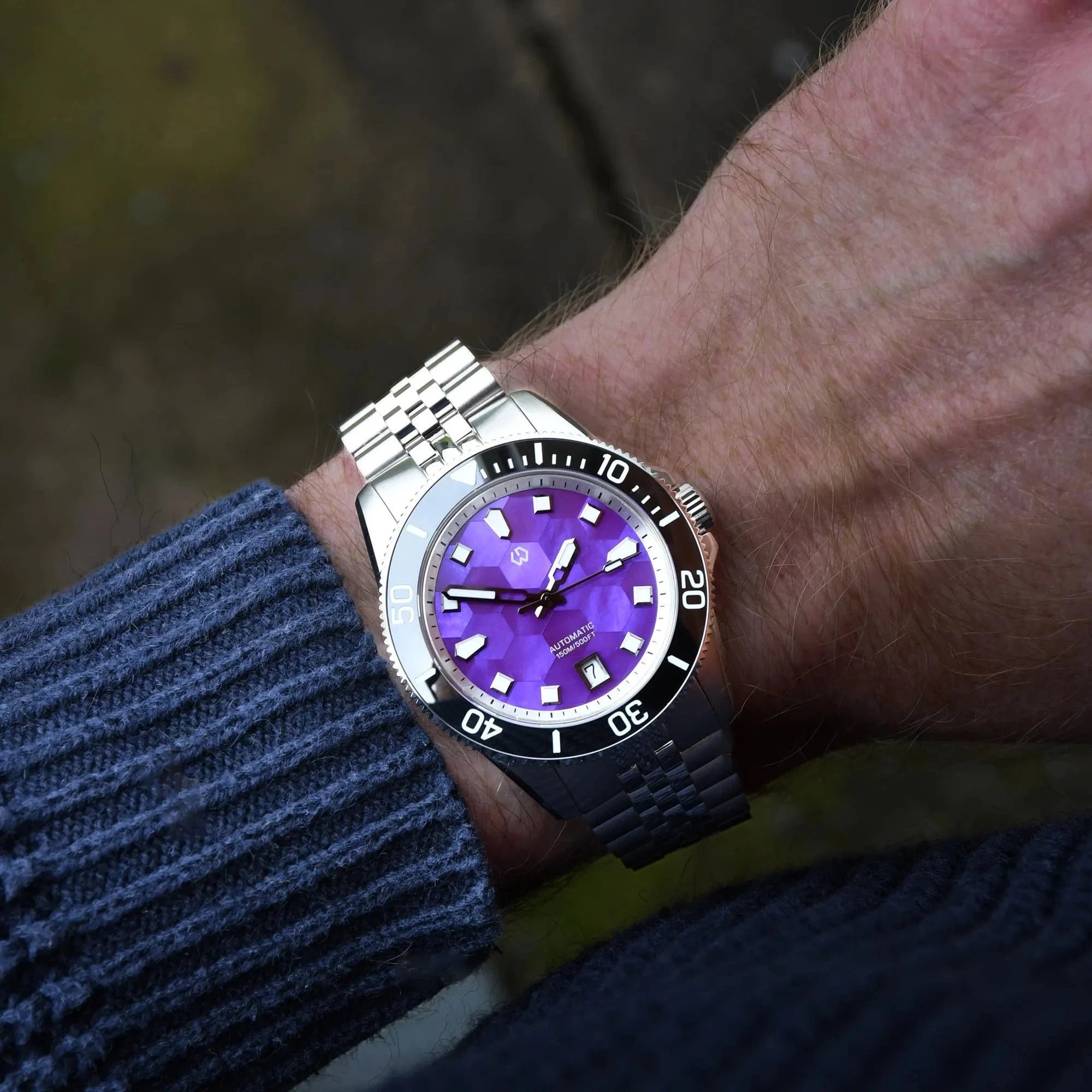


In the world of mechanical watch movements, frequency matters. It's measured in vibrations per hour (vph) or hertz (Hz), and it determines how many times the balance wheel oscillates every second. Common frequencies range from 18,000 vph (2.5 Hz) to 36,000 vph (5 Hz). But what does this actually mean for you, the person wearing the watch?
Let's break down the trade-offs between high and low frequency movements, and help you decide which suits your priorities.
What Frequency Actually Means
The balance wheel is the heart of a mechanical watch. It oscillates back and forth, and each oscillation is divided into "ticks" that advance the gear train. The frequency tells you how many times the balance wheel completes its cycle per hour.
-
18,000 vph (2.5 Hz): 5 ticks per second
-
21,600 vph (3 Hz): 6 ticks per second
-
28,800 vph (4 Hz): 8 ticks per second
-
36,000 vph (5 Hz): 10 ticks per second
Higher frequency means more ticks per second, which generally translates to a smoother sweeping seconds hand and potentially better accuracy.

The Case for High Frequency (28,800 vph and above)
High frequency movements offer two primary advantages:
Smoother Sweep
At 28,800 vph, the seconds hand moves in eight visible steps per second. At 36,000 vph, it's ten steps. The human eye perceives these as a near-continuous glide. Enthusiasts often describe this as "buttery smooth" compared to the more noticeable ticking of lower frequency movements.
Better Theoretical Accuracy
Higher frequency makes the movement less susceptible to positional errors and shocks. If the balance wheel receives a disturbance, it recovers more quickly because it oscillates faster. This can translate to more stable timekeeping across different wrist positions throughout the day.
Examples of High Frequency Movements:
-
ETA 2824-2 (28,800 vph)
-
Sellita SW200-1 (28,800 vph)
-
PT5000 (28,800 vph) – a caliber recently adopted by Wishdoit watches for upcoming models
-
Grand Seiko Hi-Beat (36,000 vph)
The Case for Low Frequency (21,600 vph and below)
Lower frequency movements have their own compelling advantages:
Greater Power Reserve
Lower frequency consumes less energy. A watch beating at 21,600 vph can often achieve a longer power reserve than a similar movement at 28,800 vph. Some modern low-frequency movements deliver 70-80 hours of reserve from a single wind.
Less Wear and Tear
Fewer oscillations per second means fewer component interactions over time. The balance staff, pallet fork, and escapement teeth all experience reduced cumulative stress. In theory, this can contribute to longer service intervals and extended movement life.
Proven Robustness
The most bulletproof movements in watchmaking history often operate at lower frequencies. The Seiko NH35 (21,600 vph) and Miyota 8215 (21,600 vph) have earned reputations for surviving conditions that would challenge more delicate high-beat calibers.
Examples of Low Frequency Movements:
-
Seiko NH35 (21,600 vph)
-
Miyota 8215 (21,600 vph)
-
ETA 2801-2 (21,600 vph)
-
Many vintage and manual-wind movements (18,000 vph)

The Middle Ground: 28,800 vph as the Modern Standard
For most contemporary mechanical watches, 28,800 vph (4 Hz) has become the default. It offers an excellent balance: smooth enough sweep to satisfy most enthusiasts, accuracy sufficient for daily use, and power reserves typically in the 38-42 hour range.
Movements like the PT5000 that operate at 28,800 vph demonstrate that high frequency doesn't have to mean fragile or expensive. When Wishdoit watches selected this caliber for their upcoming geometric dial model, they chose a frequency that delivers a satisfying sweep without compromising reliability.
The Practical Difference: Can You Actually Tell?
Here's an honest answer: most people cannot reliably distinguish between 21,600 vph and 28,800 vph by looking at the seconds hand alone. The difference exists, but it's subtle. Place a 21,600 vph watch next to a 36,000 vph watch, and you might notice. In isolation? Unlikely.
Where you might notice is in long-term accuracy. A well-regulated high frequency movement has the potential to maintain better time across different wrist positions. But a well-regulated low frequency movement can still perform within COSC standards. The movement's quality of regulation matters as much as its raw frequency.
What About 36,000 vph (Hi-Beat)?
Movements at 36,000 vph represent the upper tier of frequency. They offer an exceptionally smooth sweep and outstanding theoretical accuracy. But they come with trade-offs: reduced power reserve (typically 50-55 hours maximum), more frequent service requirements, and significantly higher manufacturing costs.
Grand Seiko's Hi-Beat movements and vintage Zenith El Primero chronographs are famous examples. They are magnificent achievements. They are also overkill for most daily wear situations.
Which Frequency Is Right for You?
Choose Higher Frequency (28,800+ vph) if:
-
You value a smooth sweeping seconds hand
-
You enjoy knowing your watch uses modern manufacturing standards
-
You want the theoretical best accuracy from a mechanical movement
-
You're comfortable with standard power reserves (38-42 hours)
Choose Lower Frequency (21,600 vph or below) if:
-
You prioritize longer power reserve over sweep smoothness
-
You prefer proven, ultra-reliable workhorse movements
-
You own vintage watches (most operate at lower frequencies)
-
You want maximum durability for active daily wear
The Verdict
Neither frequency is objectively "best." The right choice depends on your priorities. A high frequency movement offers a smoother sweep and potentially better accuracy. A low frequency movement offers longer power reserve and proven robustness. Both, when well made and properly regulated, will serve you faithfully for years.
For most daily wear situations, the modern standard of 28,800 vph hits the sweet spot. It's smooth enough to satisfy, reliable enough to trust, and available at accessible price points—including in the upcoming PT5000-powered models from Wishdoit watches.
Because the best frequency isn't the highest number on a spec sheet. It's the one that keeps your watch running accurately, day after day, without demanding attention.
You'll also like
Which table mirror material is good,mineral crystal glass or sapphire crystal glass ?
Inspired by Earth: The Story Behind the GMT World Time Watch Design
Manual vs. Automatic Winding: A Complete Guide to Setting and Using Mechanical Watches