
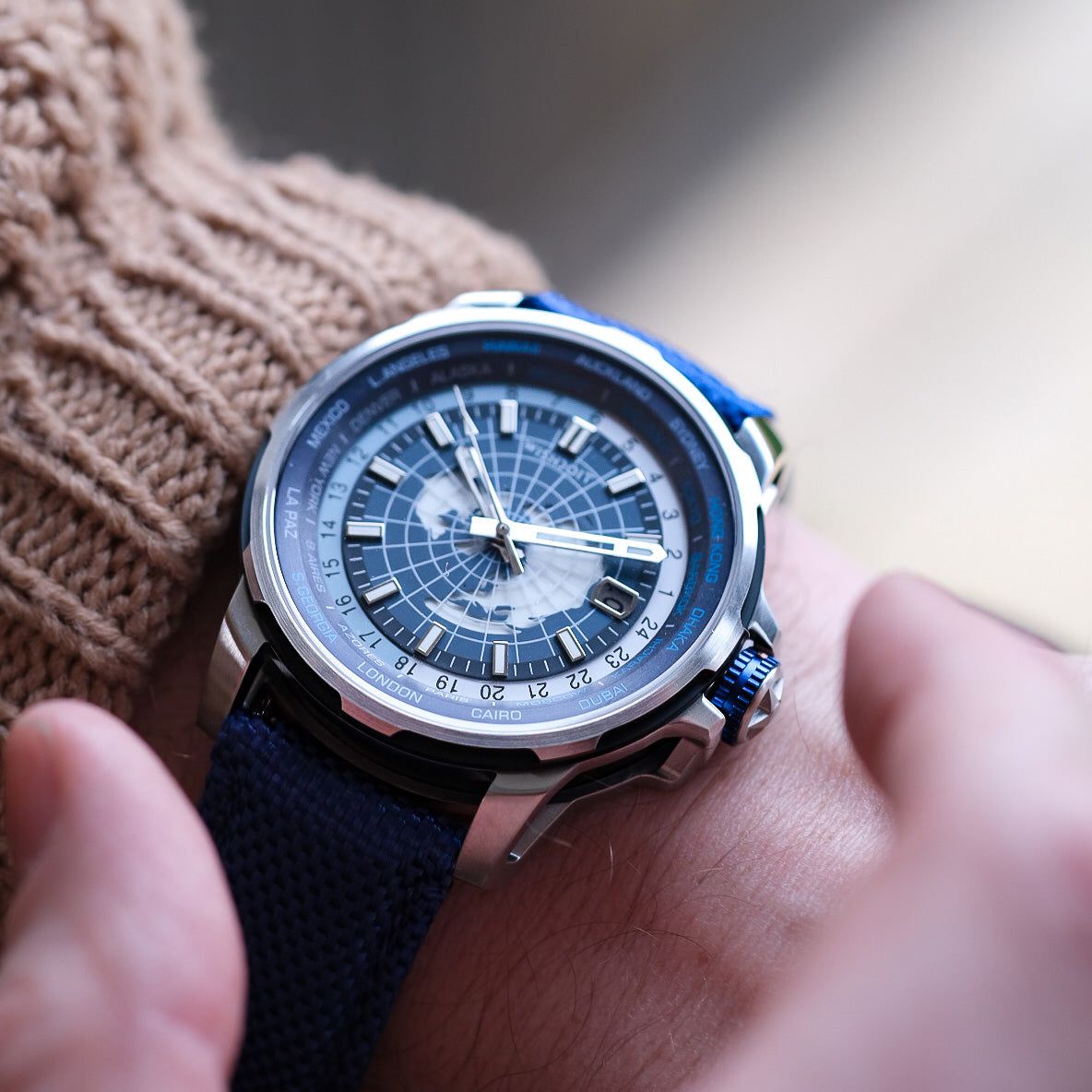


The alarm goes off in a hotel room. Your body says one time. Your phone says another. Somewhere across the ocean, someone you love is waking up—or going to sleep. For the modern traveler, time is no longer singular. It is layered. This is why a GMT watch transforms from a complication into a necessity.
What a GMT Actually Does
A GMT watch tracks two time zones simultaneously. The main hands show your local time. An extra 24-hour hand points to a second time zone, typically read against a 24-hour scale on the bezel or dial. That second hand completes one full rotation every 24 hours, not 12, so it distinguishes AM from PM at a glance.
With a true GMT movement, you can adjust the local hour hand independently without stopping the watch. This means your home time (tracked by the 24-hour hand) keeps running accurately while you set the main hands to your new destination. No math. No confusion. No missed calls to family.

The Real Cost of Not Having a GMT
Before GMT watches became accessible, travelers did mental math. "If it's 3 PM here, it's 9 PM back home." That works until you cross enough time zones that exhaustion erases basic arithmetic. Jet lag blurs the numbers. You call at the wrong hour. Or you miss the window entirely.
A GMT watch eliminates that cognitive load. You glance at your wrist. The 24-hour hand tells you instantly what time it is where it matters. The main hands tell you where you are. One watch. Two time zones. Zero mental math.
Beyond the Flight: Everyday GMT Utility
Even between trips, a GMT serves daily life:
-
Working with remote teams across time zones
-
Family members studying or living abroad
-
Tracking a second time zone for financial markets
-
Simply appreciating the mechanical ingenuity of a 24-hour complication
A GMT watch isn't a travel accessory. It's a connection tool. It keeps you linked to the people and places that matter, no matter how many miles separate you.

True GMT vs. Caller GMT: Know the Difference
Not all GMT watches work the same way. Understanding the distinction prevents disappointment:
True GMT (or "Traveler's GMT"): The local hour hand adjusts independently in one-hour jumps. The 24-hour hand (set to home time) remains running. This is the traveler's choice. You land, pull the crown to the first position, and click the local hour forward. The watch keeps perfect home time reference throughout.
Caller GMT (or "Office GMT"): The 24-hour hand adjusts independently. The main hands continue running normally. This works well if you always need to reference a fixed second time zone (like your company's headquarters) but don't frequently change local time yourself.
For frequent travelers crossing multiple time zones, a true GMT is worth seeking.
GMT on a Budget: The NH34 Revolution
The Seiko NH34 movement changed the GMT category. Before its release, true GMT complications lived at much higher price points. The NH34 brought independent local hour adjustment, 28,800 vph smooth sweep, and reliable automatic winding to accessible watches.
This movement powers many modern affordable GMTs, including models within the Wishdoit watches collection. For travelers who want genuine functionality without spending a month's travel budget on the watch itself, the NH34 opened doors.
The Wishdoit Approach to GMT
Wishdoit watches have embraced the GMT complication thoughtfully. Models like the Abyss Voyager pair a true GMT movement with dive-worthy construction—200m water resistance, ceramic bezel, sapphire crystal. This combination makes sense for the traveler who doesn't stay at desks. You can track two time zones from a beach, a boat, or a boardroom.
The brand's philosophy applies here as elsewhere: essential functionality shouldn't require essential expense. A capable GMT watch from Wishdoit watches delivers the core travel tool without the luxury markup.
Who Should Buy a GMT?
A GMT watch makes sense for:
-
Frequent flyers crossing three or more time zones regularly
-
Remote workers collaborating across continents
-
Anyone with family abroad who wants instant connection
-
Collectors who appreciate useful complications
A GMT is less useful for:
-
Travelers who rarely leave their time zone
-
Those who prefer using their phone for everything
-
Minimalists who find any complication visually distracting
The One-Watch Travel Collection
If you could only own one watch for travel, a GMT diver might be it. Water resistance for beaches and pools. GMT function for time zones. Robust construction for unpredictable conditions. Legible dial for quick reading in bright sun or dark hotel rooms.
This is why GMT dive watches have become so popular. They don't ask you to choose between capability and utility. They deliver both.
Final Thought
A GMT watch doesn't just tell time. It tells times—plural. It acknowledges that your life spans more than one clock. It keeps you connected to home while you explore away from it.
For the traveler who values both function and feeling, a GMT on the wrist is more than a tool. It's a tether. And in a world of constant motion, that tether matters.
Because the best travel companion doesn't just count the hours. It keeps you close to the ones you're counting them without.
You'll also like
Why do watch hands get stuck? Common causes and simple solutions
Speed and passion: The perfect combination of watches and racing cars
Waiting for a Breakdown? Why Regular Watch Inspections Save You Time and Money